Here's a connection between the growth of a child to the growth of a bamboo, in relations to spiritual practice in Tai Chi.
I'm playing around with this idea to relate the growth of a child to that of a bamboo: A child grows and develops physically in the metaphorical "long smooth section" in bamboos, where "sprouts of creativity shoots" from the knobs, when lessons and bumps are encountered in the course of a child's life. In the end, each increment grows taller and taller and eventually, over time-change of weather-adaptation-perhaps growth pains- into an adult form.
I quote from this blog:
"The knobbly bit represents the class (this guy is taking Tai Chi), the long smooth section (is) the practice.
Notice that the sprouts grow from the knobbly part. This is where creativity shoots from. The knobbly part is the lesson and also a relaxing period. The long stem is the work and practice section, this is where Tai Chi happens. In class we learn, but without practice it is meaningless. So my new mantra is practice, practice, practice with a little bit of learning every once in a while."
Thursday, April 17, 2008

Sunday, April 13, 2008
Johnny Lee talks at TED
The subject line is quite self explanatory :) Looks like Johnny is receiving a lot of good attention from his research. Good for him.
http://www.ted.com/talks/view/id/245
G
http://www.ted.com/talks/view/id/245
G
Drag & Draw - A Digital Painting Kit
I was just sent this link by a friend and thought it would be a great resource for our ongoing research. Philips is developing this digital painting kit geared at children where the idea is you paint with light. Ehhh you say, saw this before, well, by simply waving the crayon/wand, you can animate the light drawings. It's magic, haha. The digital 'paint bucket' they present is amazing too.
http://www.techeblog.com/index.php/tech-gadget/video-philips-digital-light-painting-kit
Enjoy!
http://www.techeblog.com/index.php/tech-gadget/video-philips-digital-light-painting-kit
Enjoy!
Tuesday, April 8, 2008
Crayon Prototype - Finally
Garrett completed our crayon prototype a couple of weeks ago and since I am responsible for working out some of the software glitches it has been in my possession. Unfortunately I kept forgetting to put up pictures so as promised here they are!

The entire crayon prototype.

The Tip - side view

The Tip - Top view
(Yes it's a bouncy ball!)

Finally the guts...

As for the software glitches we are having some issues getting a proper movement ratio from the crayons so I will continue to work on that and hopefully have a solution for Thursday. Everyone cross their fingers!

The Tip - Top view
(Yes it's a bouncy ball!)

Finally the guts...

As for the software glitches we are having some issues getting a proper movement ratio from the crayons so I will continue to work on that and hopefully have a solution for Thursday. Everyone cross their fingers!
Saturday, April 5, 2008


Wednesday, April 2, 2008
Mices...
The mice have finally arrived in the mail today...all three :) So my next step is to open 'em up and see what they can do. I hope they work as well as I think they will. Again, these mice utilize Bluetooth connections good for a range of 10m, or so the package says.
I also did a little talking with both IKG staff and Curtis Burns, and have relayed our need to use the middle space in the mainmall for the installation. Apparently the space is not under the control of the gallery, but Curtis said that our use of it was fine. It does work more like a general access area, so we should claim the space as soon as we see fit. AV also has an extending arm that we can use to attach a mirror, so that will work good.
In regards to the musical grid, I'm still researching the idea of using 'cossonate' (pleasant sounding) intervals for the notes. I hope to have something soon that we can apply.
That is all...for now.
I also did a little talking with both IKG staff and Curtis Burns, and have relayed our need to use the middle space in the mainmall for the installation. Apparently the space is not under the control of the gallery, but Curtis said that our use of it was fine. It does work more like a general access area, so we should claim the space as soon as we see fit. AV also has an extending arm that we can use to attach a mirror, so that will work good.
In regards to the musical grid, I'm still researching the idea of using 'cossonate' (pleasant sounding) intervals for the notes. I hope to have something soon that we can apply.
That is all...for now.
Monday, March 31, 2008
Useful links
The following is useful in our future research:
http://psychology.ucalgary.ca/CCD/child/
"The Ch.I.L.D. Research Group at the University of Calgary is made up of four developmental psychologists who are interested in how infants and children develop language, learning, and social understanding."
http://psychology.ucalgary.ca/CCD/child/
"The Ch.I.L.D. Research Group at the University of Calgary is made up of four developmental psychologists who are interested in how infants and children develop language, learning, and social understanding."
Developmental Stages

A brief breakdown of a child's growing stages.
Image taken from:
http://www.emergency.dsl.pipex.com/images/development.jpg
Sunday, March 30, 2008


Summary
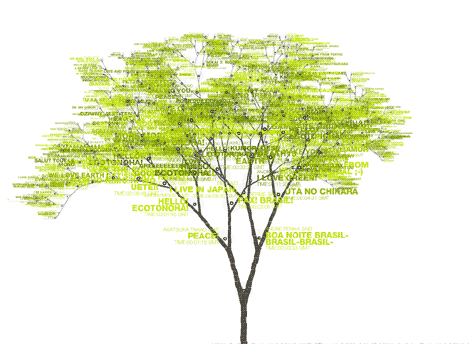
We have finalized the decision of our wall space. Working with the environment at ACAD in using their existing elevated step-seats, we are to juxtapose pictorially a child's developmental stages vs. that to the growth of a tree.
Themes we explored:
Perspective from a “child’s point of view”.
Oversize chair and table/ Classroom setting, floating alphabets and numbers/ Whimsical ambiance. Ex) flying elephants
We need to...
1. Book ACAD Main Mall area - contact Curtis Burns / Michael at ACAD
2. Find: dimensions of the wall space/ speakers / Monitor.
others: carpet flooring / toy trunk / shoe rack.
3. Decide on wall space material: foam core, wallpaper, canvas.
Floor space is dependent on room dimensions.
4. Ethics: Ethics application
Videotape (?) to observe participants to emphasize “natural flow”. Less obtrusive(?)
Consider actions of
1) the participating party
2) researchers
This could get expensive quickly.
Themes we explored:
Perspective from a “child’s point of view”.
Oversize chair and table/ Classroom setting, floating alphabets and numbers/ Whimsical ambiance. Ex) flying elephants
We need to...
1. Book ACAD Main Mall area - contact Curtis Burns / Michael at ACAD
2. Find: dimensions of the wall space/ speakers / Monitor.
others: carpet flooring / toy trunk / shoe rack.
3. Decide on wall space material: foam core, wallpaper, canvas.
Floor space is dependent on room dimensions.
4. Ethics: Ethics application
Videotape (?) to observe participants to emphasize “natural flow”. Less obtrusive(?)
Consider actions of
1) the participating party
2) researchers
This could get expensive quickly.
Monday, March 24, 2008
Musical Drawing - Note Grid

Above is the grid that will be used for the notes. We are currently using G major.
ACAD wallspace
Kara Walker
http://mamasaidshop.typepad.com/mamasaid/nursery/index.html
mocoloco.com/art/archives/002548.php
http://sikkemajenkinsco.com/karawalker_works.html
http://www.designspongeonline.com/2007/05/stationery-show-2007-part-two.html
http://mamasaidshop.typepad.com/mamasaid/nursery/index.html
mocoloco.com/art/archives/002548.php
http://sikkemajenkinsco.com/karawalker_works.html
http://www.designspongeonline.com/2007/05/stationery-show-2007-part-two.html
Musical Drawing
We now have a note playing as you draw with any of the three crayons and eraser. Each of the crayons are a different instrument and the eraser is our percussion. While it has been determined that the eraser is percussion the other three instruments are still up in the air and will most likely be determined at a later date as the midi player we are using makes it simple to change these as needed.
Currently the program is moding the mouseX and mouseY and using the sum to pull a note from an array of notes. Eventually this will be updated to use an invisible grid with each note allocated a square. This will also be done using mouseX and mouseY.
Currently the program is moding the mouseX and mouseY and using the sum to pull a note from an array of notes. Eventually this will be updated to use an invisible grid with each note allocated a square. This will also be done using mouseX and mouseY.
Monday, March 17, 2008
Crayon Prototypes - Take 2
After some trial and error together with much thought, I've come up with a new direction for developing the crayon interfaces. I've included a schematic of what I want to pursue below.

Included in this diagram is a hybrid system of registering the movement of the crayon that uses ideas from both a trackball and an optical guided system. After running into frustration with getting the optical mouse circuit alone to relate movement (the tube had to be perfectly upright and also pressed against a sufficiently smooth surface with just the right amount of texture), I believe this more versatile hybrid approach will work much better. Not only will it allow play over any type of surface, but it also works well at slight tilt angles, something the optical system alone can not do. The only drawback I can see is the precision that'll have to go into engineering these devices and if I can do it by hand.
-------------------------------------------
Though we have essentially removed from this first draft of the project any idea of animation or object interactivity, I still think it's important to keep these things in our minds. Here is a very cool 2D drawing physics engine that can be of inspiration for the down the road. It's called 'Phun' and it's described as "the 2D physics sandbox!". Watch the video and install the program if you like. It's in BETA and free to use...just don't make profit off it.
http://phun.cs.umu.se/wiki
That's all I have for now. Thank you Nick for pointing me towards the Phun engine.
G

Included in this diagram is a hybrid system of registering the movement of the crayon that uses ideas from both a trackball and an optical guided system. After running into frustration with getting the optical mouse circuit alone to relate movement (the tube had to be perfectly upright and also pressed against a sufficiently smooth surface with just the right amount of texture), I believe this more versatile hybrid approach will work much better. Not only will it allow play over any type of surface, but it also works well at slight tilt angles, something the optical system alone can not do. The only drawback I can see is the precision that'll have to go into engineering these devices and if I can do it by hand.
-------------------------------------------
Though we have essentially removed from this first draft of the project any idea of animation or object interactivity, I still think it's important to keep these things in our minds. Here is a very cool 2D drawing physics engine that can be of inspiration for the down the road. It's called 'Phun' and it's described as "the 2D physics sandbox!". Watch the video and install the program if you like. It's in BETA and free to use...just don't make profit off it.
http://phun.cs.umu.se/wiki
That's all I have for now. Thank you Nick for pointing me towards the Phun engine.
G
Monday, February 11, 2008
Crayon Prototypes


Several variations of crayons came to being, and two ideas came to our attention as scanned above.
First model failed because we implemented acrylic paint on cardboard. Even though we sprayed acrylic primer and applied gesso on two individual experimentations, and used gloss medium as a finish, the result looked unprofessional and generally unattractive.
We reached a consensus on the Plexiglass tubings so long as costs are low. "Cast tubing" ~$125 is the most expensive material that we know of, followed by "Extruded", and finally "Plastic tubing" being the most cost effective for ~$30.
We require three 1/8" width plastic tubing with 3" Inside Diameter by 24" in height.
For future references:
1. I.P.P. Industrial Paints & Plastics (Chinook Center) - acrylic plastic tubings available in Calgary.
5-5558 1st. Street S.E.
http://www.ippnet.com/EN/main/locations/2625.html
2. Ge Polymar Shapes (order from Vancouver)
103 1440 Avaiation Park NE
ph: 250-1670
3. Industrial Paint & Plastics
5-5558 1st Stree SE
ph: 252-8368
4. Chinook Plastics LTD
3130 12th NE
ph: 250-7484
5. East West Plastic & Electric Product
519-36 Ave SE
ph: 243-8333
We are still rearranging several possible positions for the inside devices. For example finding the material to maximize the protection and usage for LED, placement for "leads" to a on/off switch, a secure way to connect a funnel to a plastic tubing,
using pressure sensitive foam (FSR) as a possible resource for our crayon.
The circled components in image Crayonprototyle2 are of concern for now. We are also planning to put lighting in corresponding color inside the plastic tube to add visual interest to our project.
In terms of exhibition space, we could test drive the finished product at a Daycare center (area and permission conditionally agreed), and even the Telus World of Science (to be determined).
Go team crayons!
Monday, January 28, 2008
DOOZLA
"Doozla is the easy-to-use drawing application for children - it is what your kids have always wanted!"
Here is a link to nice little "Play to Learn" painting program for children that looks quite interesting. It might be worth downloading and playing with I think :)
plasq.com/doozla
Also, for a little history on computer aided drawing, here is a link to a YouTube video on Sketchpad by Dr. Ivan Sutherland. I'm not sure exactly when the video of the sketching program was made, but it could be as far back as the early 60s.
I would like to thank Daniel Dugas for bringing these links to my attention.
Here is a link to nice little "Play to Learn" painting program for children that looks quite interesting. It might be worth downloading and playing with I think :)
plasq.com/doozla
Also, for a little history on computer aided drawing, here is a link to a YouTube video on Sketchpad by Dr. Ivan Sutherland. I'm not sure exactly when the video of the sketching program was made, but it could be as far back as the early 60s.
I would like to thank Daniel Dugas for bringing these links to my attention.
Thursday, January 17, 2008
Tentative project title: Think Inside the Box(?)
 The music: All Access was denied to us as the exhibition was taken down by the time we arrived. :( On a brighter note...
Our visit to the Telus World of Science resulted in two findings: the use of projector screens/IR and its shadows played on the (a)wall vs. (b)floor.
a) a solar system wall projection with planets spinning at increasing speed dependent to our movements.
b) the floor piece is projected into a mirror and produced a pond filled with goldfish on the floor. Ripples appear as a response to external stimulus such as human interaction. We notice our shadows were of modest size, and therefore alleviate one of our initial worries of intruding black "blobs".
The use of motion tracking is prominent in both examples. With this finding, we begin this weekend by tackling the WiiMote control, as well as decipher codings and search proper material for the Crayon maquette.
p.s. Image post as requested. (Apologies for the overexposure!)
Cheers!
Joyce
Saturday, January 12, 2008
Welcome
Welcome to our research blog.
The focus of this project is to develop a creative learning environment for children. This will involve the use of colour, sound and animation.
In order to further understand the sound aspect of our project we will be visiting the Telus World of Science on Tuesday January 15. Our focus will be on the Music: All Access exhibit.
This site will be maintained by Garrett Baumgartner, Joyce Wong and Nicole Dempsey.
The focus of this project is to develop a creative learning environment for children. This will involve the use of colour, sound and animation.
In order to further understand the sound aspect of our project we will be visiting the Telus World of Science on Tuesday January 15. Our focus will be on the Music: All Access exhibit.
This site will be maintained by Garrett Baumgartner, Joyce Wong and Nicole Dempsey.
Subscribe to:
Posts (Atom)